Patient Experience Benchmarking: Turning Patient Voices into Strategic Decisions
AUTHOR: Dave Muggler- President PatientSight | PUBLISHED: Jun 30, 2026
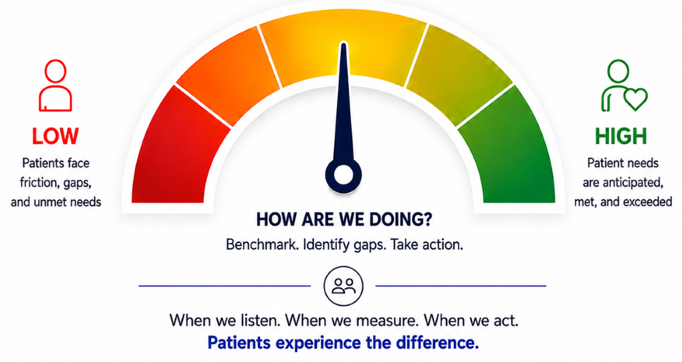
There has been a lot of talk in the life science industry about patient-centricity in recent years, and many companies have made honest efforts to move more in that direction. But how do we know what the impact of that push is? Many organizations still rely on fragmented research or customer satisfaction metrics that fail to capture the complete patient journey.
The Patient Experience Benchmark Report was developed to address this gap.
Unlike traditional patient research, this report provides a structured framework for measuring the real-world patient experience across the entire journey. Using standardized indices, it enables organizations to quantify strengths/weaknesses, identify unmet needs, and track progress over time.
It helps answer the question, “What does good look like?" from the perspective of the end customers. We look at this in two ways: changes over time and comparisons between segments or brands. For example, with a sample of 102 myasthenia gravis patients, we saw that overall disease burden improved since the time of diagnosis, but those with severe disease show the reverse, suggesting that more needs to be done in that segment.
Moving along the patient journey path, the data shows that newer treatment experiences were not significantly better than those for older ones. Closer examination reveals the likely reason- new therapies have a greater proportion of patients with severe disease. Perhaps more could benefit if new treatments were considered in a higher number of mild to moderate cases.
We also see that most patient support programs for new brands have strong enrollment and are highly rated by users (some more than others). This sets the bar for companies planning to launch in the MG market.
The result of all this patient feedback is a comprehensive view of the patient experience that extends well beyond individual touchpoints. This approach provides a holistic view of people who live with a serious condition- what they think and feel before/during diagnosis through initial and ongoing treatment.
This assessment tool is designed for cross-functional life science teams, including Marketing, Market Research/Insights, Patient Services, and others. It provides decision-makers with actionable evidence that can inform brand strategy and prioritize investments where they will have the greatest impact.
One of the report's strengths is its benchmarking capability. Organizations can compare patient experience scores across brands, treatment approaches, patient segments, or tracking waves, allowing teams to understand not only how patients are doing today but whether meaningful improvements are occurring over time.
The Patient Experience Benchmark Report also differs from traditional Customer Satisfaction (CSAT) surveys. While CSAT measures specific interactions or services, patient experience benchmarking evaluates the broader journey and identifies the factors influencing positive or negative perceptions. This transforms patient feedback from a transactional metric into a strategic management tool.
Most importantly, the report supplements rich anecdotal patient stories with measurable business intelligence. By combining quantitative benchmarking with authentic patient perspectives, organizations gain a clearer understanding of what matters most to patients and how to translate those insights into better commercial and healthcare outcomes.